
Padel rules and scoring: a clear guide for beginners
Padel is played by four players, two against two, on an enclosed court measuring 10 by 20 metres. Scoring works as it does in tennis (15, 30, 40, game), a set goes to the first team on six games with at least two games clear, and a match is usually the best of three sets. The serve is underarm: you bounce the ball first, then strike it at or below waist height.
Written byTeam Custom Your Padel
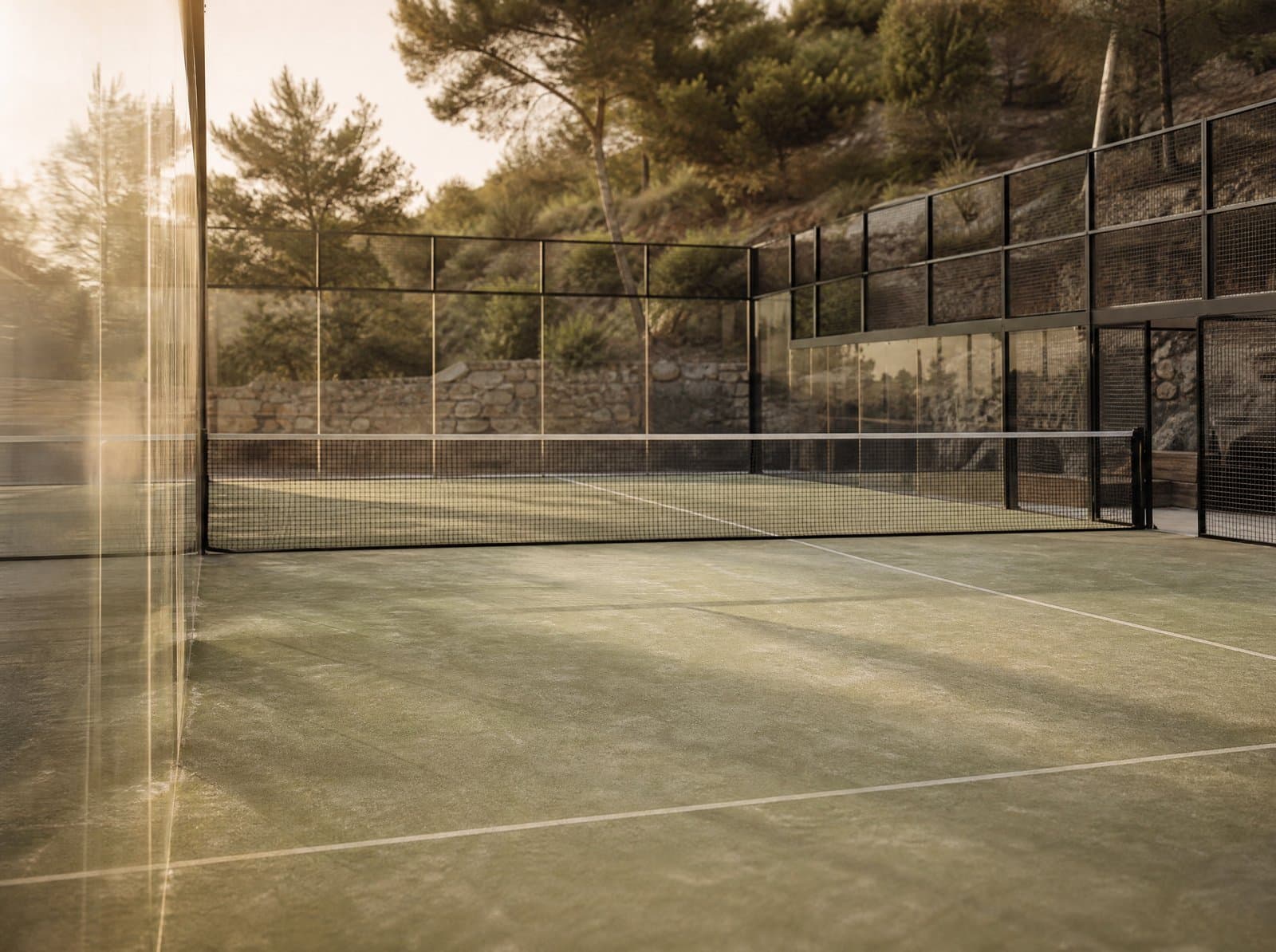
Padel looks like tennis, but the rules take their own turns: an underarm serve, walls that are part of the game, and scoring with a deciding point. This guide follows the international rulebook of the FIP (2026 version) and points out where competitions make their own choices.
The game in short
You play with two teams of two, one on each half of the court with a net between them. Every point starts with a serve and continues until a team fails to return the ball within the rules. What makes padel different: after the bounce the ball may hit the walls and the mesh, and you can use that to play it back.
The court in numbers
| Element | Measurement |
|---|---|
| Court (inside measurements) | 10 metres wide, 20 metres long |
| Service line | 6.95 metres from the net |
| Net | 88 cm high in the middle, 92 cm at the posts |
| Back wall | 3 metres of wall with 1 metre of mesh above it, 4 metres in total |
Scoring within a game
The first point is 15, the second 30, the third 40 and the fourth is game. If both teams have three points the score is 40 all, which the rulebook calls deuce. What happens next depends on the format the organiser picks.
| Format | What happens at 40 all |
|---|---|
| Advantage | You have to win two points in a row. Whoever scores first has the advantage; lose the next point and the score is level again. |
| Star point | Advantage is available twice. If the score comes level a third time, a single deciding point follows (the star point). The receiving team chooses the side. |
| Golden point | At 40 all you go straight to one deciding point. Whoever wins it wins the game. The receiving team chooses the side and the players may not swap positions. |
Which format applies is set by the league or the tournament. In a casual game you agree it beforehand. The golden point keeps games shortest.
Games, sets and the match
- A set goes to the first team on 6 games with at least 2 games clear.
- At 5 all you play two more games to win the set 7 to 5.
- At 6 all a tiebreak decides the set.
- A match is the best of three sets. Win two sets and you win the match.
- If it has been agreed beforehand that the third set is played without a tiebreak, you carry on until one team is two games clear.
The tiebreak
In a tiebreak you count points as 0, 1, 2, 3 and so on. The first team to 7 points with at least 2 points clear wins the tiebreak and with it the set. Whoever is next to serve plays the first point from the right, once. The other team then serves two points, starting on the left, after which every player serves two points in turn in a fixed order. You change ends after every 6 points.
Some competitions choose a shorter format: a mini set to 4 games, or a tiebreak to 7 points or a super tiebreak to 10 points instead of a third set. There too you need to be at least two points clear.
When do you change ends?
After the first game, after the third and after every following odd game of a set. You may rest for up to 90 seconds at a changeover, except after the first game of a set and during a tiebreak, when you change ends without a break. You have up to 20 seconds between points and up to 120 seconds between sets.
Serving in padel
The serve in padel is always underarm. Step by step, this is how it works:
- Stand with at least one foot behind the service line, between the extension of the centre line and the side wall. Do not touch the line, and stay there until you have struck the ball.
- Bounce the ball first, inside the service box you are serving from.
- Strike the ball at or below waist height, with at least one foot on the ground.
- Hit it diagonally over the net, so that the ball bounces in the service box of the opponent across from you. Lines count as in. You serve the first point from the right, then change side after every point.
- A fault gives you a second serve. Two faults in a row cost you the point.
A serve is a fault if, among other things:
- you miss the ball or hit it outside the receiver’s service box;
- the ball touches you or your partner;
- the ball bounces in the correct box and then hits the mesh before bouncing a second time (hitting the glass is not a fault).
If the serve clips the net and still lands in the correct box, that is a let and the serve is replayed. If it happens on the second serve, only that second serve is replayed.
At the start of every set the team decides who serves first and who receives on which side. That order stays the same for the whole set.
The return
The receiver lets the ball bounce in the service box first and then returns it, before it bounces a second time. The receiver may stand anywhere on their own half, as may both partners. If the serve hits the receiver before it has bounced, the point goes to the server.
The rally and the walls
- Once the serve is in play you may hit the ball out of the air (a volley) or after a bounce.
- Your shot has to bounce on the floor on your opponents’ side first. If it hits their wall or mesh first, it is out.
- If the ball bounces on your half and then goes into your wall or mesh, you may still play it before it bounces on the floor a second time.
- You may also play the ball into your own wall first and send it into your opponents’ half that way.
- If the ball bounces in your opponents’ half and then flies out of the court, the point is yours.
- Playing outside the court is only allowed on courts built for it, with clear space and access gates. Many courts do not have this.
When do you lose a point?
You lose the point if, among other things:
- the ball bounces twice on your half before you play it;
- you, your racket or anything you are wearing touches the net, the posts or the cable during the rally, or you jump over the net;
- you hit the ball before it has crossed the net;
- you hit the ball twice, or you and your partner both touch it;
- after your shot the ball hits you, your partner or anything either of you is wearing;
- the ball hits your body or clothing (not your racket) after your opponent has struck it;
- your shot hits your own floor or the mesh on your own side first;
- your shot hits your opponents’ wall or mesh without bouncing on the floor first;
- you put a foot or any part of your body outside the court where playing outside the court is not allowed;
- you drop your racket or the wrist cord breaks (that rule is in the 2026 version);
- you serve two faults in a row.
Common beginner mistakes
- Serving overarm. Not allowed: the ball has to be struck at or below waist height.
- Standing on the service line. That is a fault, even if only a toe touches it.
- Letting the ball go into the wall. Without a bounce on your opponents’ floor first, the ball is out.
- Touching the net. With your racket or your clothing it still costs the point.
- Playing without a wrist cord. The cord is compulsory. It may not be elastic and may not be longer than 35 centimetres.
- Not knowing which scoring format applies. Ask beforehand, certainly in a league or a tournament.
No racket yet?
If you are just starting out you do not need an expensive racket straight away. Read which padel racket suits a beginner or start with what padel is and how it works. If you want a racket with your own name or design on it, you make that in the designer.
One note: this article describes the international rulebook. In official matches, the organiser’s regulations always apply.
Read next
- Guide
Padel in the UK and Ireland: how to start and what it costs
Padel has gone from a rarity to a normal weekend booking in the UK and Ireland. Where you play, how to start, what a racket costs and how delivery works.
- Guide
What is a custom padel racket? Meaning, differences and prices
A custom padel racket is a professional racket personalised with your own design. What it means, how it differs from brand rackets, and prices from €99.99.
- Gift
Padel racket with a name: a personal gift for any padel player
A padel racket with a name on it, as a gift or for yourself. How it works, what it costs and how it arrives within 10 days anywhere in Europe. From €99.99.