
Custom padel racket in a tournament: what the rules allow
The FIP Rules of Padel, which LTA competitions follow, regulate a racket’s size, build and safety, not its artwork. Nothing in them rules out a custom padel racket with a name or logo, as long as the design does not distract other players. It must stay within the measurements, have no reflective surface and carry a wrist cord.
Written byTeam Custom Your Padel
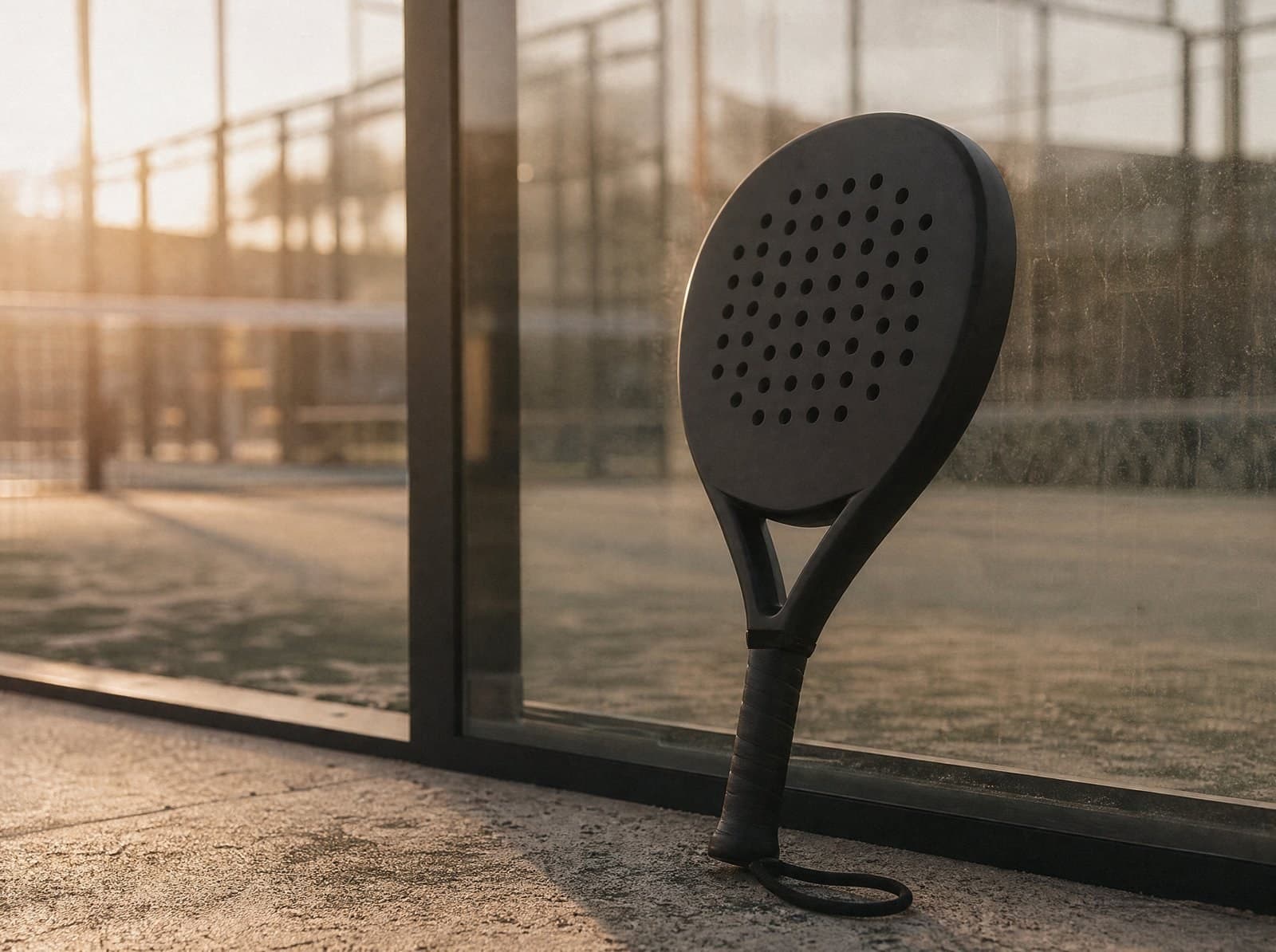
A week before a league match or a club tournament, players ask us the same thing: can I bring my own racket if it has my own design on it? Here is what the rules of the International Padel Federation (FIP) say in the version that applies from 1 January 2026, how they reach LTA competitions in Great Britain, and where the answer depends on the organiser.
Which rules LTA padel competitions follow
The LTA’s 2026 referee and organiser guide says its sanctioned padel competitions, graded 1 to 5, are delivered under the Rules of Padel and the LTA Competition Regulations. For the rules themselves it links to the FIP Rules of Padel. That FIP document is therefore the text that counts for your racket.
What the FIP rules say about a custom padel racket
The rules set out dimensions and construction. They say nothing about colours, names or artwork. The main requirements:
| Part | Requirement |
|---|---|
| Total length (head plus handle) | 45.5 cm at most |
| Handle | At most 20 cm long, 50 mm wide and 50 mm thick |
| Head | At most 26 cm wide and 38 mm thick (2.5% tolerance on thickness) |
| Holes in the hitting surface | Cylindrical, 9 to 13 mm in the central area; up to 20 mm within 4 cm of the edge |
| Hitting surfaces | Both sides flat, smooth or rough |
| Wrist cord | Compulsory, non elastic, 35 cm at most, fixed to the handle |
Three more points matter for a personalised racket. Nothing may be attached to it unless it limits wear or vibration or distributes the weight, and such parts must be reasonable in size and position. The racket must not confuse or disturb the other players, so it may have no reflecting surface and no sound elements that could affect play. And it may carry no visible or audible device that gives the player instructions during a match.
On equipment in general, the rules say players may use the shoes, clothing and rackets they want, provided they comply with the rules.
What that means for your own design
- A name, logo or colour on the face is decoration. It adds no object or device and does not change the length or width of the racket.
- We apply designs as a full colour print with a UV resistant protective layer. It lies flat on the face and is not an added part.
- Do not stick reflective tape, mirror foil or loose extras on the racket afterwards. The ban on reflecting surfaces is written out in full.
- Choose a design that will not confuse the pair across the net, so no print that looks like a ball.
There is one grey area. The rule on attached objects talks about parts and devices, and a design is graphic. A referee may still see it differently, especially at a higher graded event. If you are unsure, ask before the draw is made.
Homologation, said plainly
The racket section of the rules opens by saying the game is played with a racket made in accordance with the FIP annex on racket homologation. We do not claim FIP homologation for our base racket, so do not assume it has it. If you play events where the referee or organiser asks for a homologated racket, a brand racket is the safe choice on match day. We compare the two honestly in custom padel racket vs brand racket.
Where a custom racket fits
- Club nights, box leagues and americanos at your venue.
- Company tournaments and team days. Ideas for the prize table are in padel tournament prizes.
- As a second racket next to your match racket, for training and friendly games.
- As a gift for a player who mostly plays socially.
Checklist before match day
- Ask the organiser or the referee which racket requirements apply.
- Check the wrist cord. Under the 2026 rules a pair loses the point immediately if a player breaks the safety cord or drops the racket.
- Make sure nothing reflective or loose has been added to the racket.
- Bring a spare racket if you are in doubt. The rest of the rules, from the serve to the scoring, are in padel rules and scoring.
Want a racket for club nights and friendly matches? Build it in the designer or see the options and prices on our page for players. From 1 racket, finished in the Netherlands, from €99.99 with your design on the face.
Read next
- Guide
What is padel? The sport, the court and the racket explained
Padel is a racket sport for four players on an enclosed court of 10 by 20 metres. Where it came from, how it differs from tennis and what you need to start.
- Guide
Padel rules and scoring: a clear guide for beginners
How does padel scoring work, how do you serve, and when do you lose a point? The main rules explained, based on the international FIP rulebook.
- Gift
Padel gift for Father’s Day: a racket with his name on it
Father’s Day falls on Sunday 20 June 2027 in the UK and Ireland. A padel racket with his name on it costs from €99.99. Order by 7 June to be on time.